
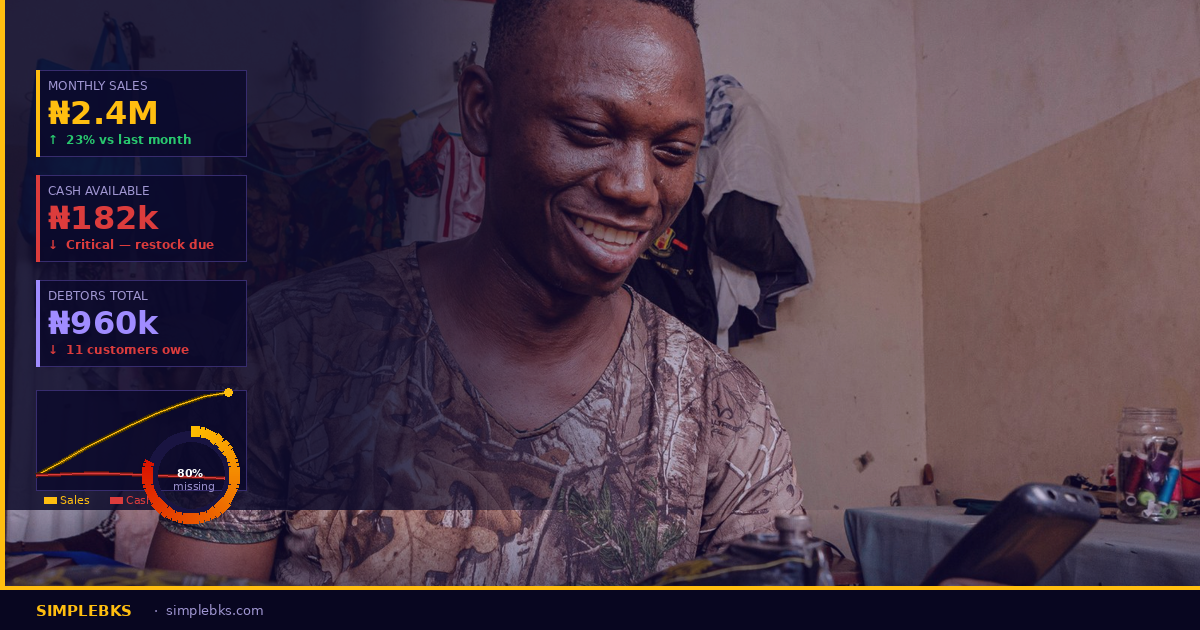
You had a good week. Customers came. Sales moved. Your WhatsApp was busy with orders. You went to bed on Friday feeling like things were working.
Then Monday comes. You need to restock. You check your account. And you're staring at a number that makes no sense given how busy the last seven days were.
This is not bad luck. It is not the economy — at least not entirely. It is a pattern. And it is happening to thousands of Nigerian business owners right now, across every industry, at every stage of business.
The shop is full of activity. The account is empty. And nobody told you why.
Busy is not the same as profitable. And profitable is not the same as having cash available.
The Real Problem Is Not That Business Is Slow
Here is the first thing to understand: this problem is not a sales problem. Most of the business owners who experience this are actually generating decent revenue. Some of them are doing very well on paper.
The problem is that revenue is not the same as profit. And profit is not the same as cash. And almost nobody explains that difference in a way that means something practical to a Nigerian small business owner trying to manage everything on their own.
In this article we cover seven reasons this happens:
- You don't know your numbers — and you're running on assumption
- You are spending the business's future without knowing it
- You are not paying yourself — so you're robbing the business instead
- Your stock decisions are based on vibes, not data
- Your prices have not kept up with your costs
- The receivables are quietly draining you
- The moment of reckoning — and the trap that follows
1. You Don't Know Your Numbers — And You're Running on Assumption
Most small businesses in Nigeria do not keep proper financial records. Not because the owners are careless people, but because nobody made it feel urgent — until it became a crisis.
What this looks like in practice: you have a rough idea of what you sell. You know when business is good and when it's slow. But you cannot tell someone right now what your actual profit was last month. You cannot say with confidence what your biggest expense is. You have no clear picture of who owes you money or how much you owe others.
When you don't have records, you make decisions based on feeling. And when business feels busy, the feeling is: money is coming, so money is there.
It isn't.
The business that has no records is like a driver navigating Lagos at night with no headlights. Things might be fine. But when something goes wrong — and something always eventually goes wrong — you will not see it coming.
2. You Are Spending the Business's Future Without Knowing It
Business is going well. The account has a balance that feels healthy. So you make a decision — a new generator, a second shop, new equipment, a bulk stock purchase, a vehicle.
The purchase feels justified. Business is good. This is the time to invest.
But nobody sat down and asked: what are my obligations for the next 90 days? What is my rent? What are my supplier payments? What do I need for restocking? What is the realistic cash I will actually collect — not just the sales I expect to make?
Business owners are naturally optimistic. That optimism is what makes someone start a business in the first place. But it becomes dangerous when it drives financial decisions. "I'll make it back" is not a cash flow plan. And a capital purchase made without understanding your cash position is how a business that was doing well suddenly can't meet basic obligations.
The rule that protects you:
Never make a significant capital or asset purchase without knowing your cash position for the next three months. Not your expected revenue. Your expected actual cash — the money that will reliably be in your account.
3. You Are Not Paying Yourself — So You're Robbing the Business Instead
This one is uncomfortable but it needs to be said directly.
Very few Nigerian business owners pay themselves a formal salary. Instead, they dip. School fees come up — take it from the business. Rent is due — take it from the business. The family needs something — the business covers it. Something nice catches your eye — the business pays.
The thinking is: it's my business, I'll sort it out later, it all comes back eventually.
It doesn't. Not in any structured way. And because there is no record of what is being taken, there is no accountability for it either. The business becomes a personal wallet — and like all wallets that are dipped into constantly without being refilled strategically, it empties.
The fix requires discipline:
Decide what you pay yourself. Pay yourself that amount on a fixed schedule. Treat everything else you take from the business as a loan that must be recorded. Take your share of profit periodically — quarterly if the business allows it. Not every month. Not whenever you feel like it. On a schedule, after you have reviewed the numbers and confirmed the business can sustain it.
This single habit — separating personal money from business money completely and paying yourself like an employee of your own company — is the most impactful change a Nigerian small business owner can make. Not the most exciting. But the most impactful.
4. Your Stock Decisions Are Based on Vibes, Not Data
Walk into many Nigerian shops and you will find two things sitting together: fast-moving products that are almost out of stock, and slow-moving products that have been on the shelf for months — tying up capital and taking up space.
This happens because most restocking decisions are made by instinct and trend rather than data. A product is popular right now, so you buy more of it. Something new is catching on in the market, so you invest in it without testing. A supplier makes a good offer on something you are not sure about, so you buy in bulk because it feels like a deal.
The result: cash is converted into stock that does not move. And cash sitting in unsold stock is cash that cannot pay rent, cannot pay staff, cannot restock the things that are actually selling.
The businesses that manage this well are not necessarily smarter. They just know which products are their highest margin, fastest moving items — and they protect those at all costs. On anything new, they move slowly and in small quantities until it proves itself.
Before committing money to new stock, ask:
Have I sold this before? If not, what is the minimum quantity I can buy to test it properly? The market will tell you if it works. You don't need to find out with your entire budget.
5. Your Prices Have Not Kept Up With Your Costs
This one is quiet. It doesn't feel like a crisis. It just slowly squeezes the margin until one day you realise you are working harder than ever for less than you used to make.
Most Nigerian small businesses price by two methods: copy what the competitor charges, or use instinct with significant room for negotiation. Neither of these accounts for what it actually costs you to run the business.
When the naira drops, imported goods cost more. When fuel goes up, logistics cost more. When inflation rises, everything from packaging to staff transport costs more. But the price charged to customers has not changed — because you are afraid to lose them, or because the market is pricing lower and you feel you have to match it.
The result: you are selling at the same price as last year but your cost is 30% higher. The sales numbers look similar. But the margin has been quietly eaten alive.
Pricing should be reviewed every quarter at minimum. The right question is not:
"What is the competition charging?" — it is: "What do I need to charge to cover my costs, pay myself, retain some profit, and still be competitive?" Those are not always the same number. But you need to know both.
6. The Receivables Are Quietly Draining You
Credit sales are a normal part of Nigerian business culture. Relationships are built on trust. Customers ask for time to pay and you say yes because they are regulars, because you want to keep the relationship, because refusing feels harsh.
But here is what is happening on the books: the sale has been recorded. The revenue exists on paper. But the cash is not there. And while you are waiting to collect, you still have to restock, still have to pay staff, still have to cover your overhead.
When receivables are not tracked — when there is no clear record of who owes what and since when — that money disappears into the business. You stop expecting it. You stop chasing it. And eventually you write it off mentally without ever writing it off formally.
For many businesses, the total amount sitting in unpaid customer credit would be enough to solve the cash flow problem entirely. But because it is not tracked and not actively managed, it is invisible.
Track every credit sale. Know exactly who owes you, how much, and since when. Chase it systematically. And set a clear personal policy on how much credit you are willing to extend at any time — and to whom.
7. The Moment of Reckoning — and the Trap That Follows
The way this crisis usually surfaces is not a dramatic moment. It is a slow accumulation until something breaks.
Usually it is the inability to meet an obligation — a supplier payment, a staff salary, a rent date — that finally makes the problem impossible to ignore. Business has been busy. But when the obligation arrives, the money is not there.
And this is where many Nigerian business owners make the problem significantly worse.
The instinct is to find money fast. So they take a loan — often at very high interest rates, from a lender who does not ask too many questions and needs the money back very quickly. The terms are brutal. And in many cases, the loan was not taken for any specific business purpose. It was taken to fill a gap.
In many cases, the loan repayment comes due and the business still has not fixed the underlying issue. So another loan is taken — sometimes to repay the first. The cycle compounds. A business that was genuinely viable becomes buried under debt it took on in desperation rather than strategy.
If you are at this point: stop. Do not take another loan until you understand exactly where the cash is going. A loan taken without a clear repayment plan built from real business data is not a solution. It is a delay that makes the eventual problem larger.
What Actually Fixes This
The answer is not one thing. But if you had to start with one change — one habit that creates the foundation for everything else — it is this:
Separate your personal money from your business money. Completely. Today.
Different accounts. Different records. A fixed amount you pay yourself — regularly, on a schedule — and nothing more unless the numbers say the business can support a profit distribution.
From there, the rest becomes possible: keeping records, understanding your real cash position, making stock decisions based on data, reviewing your pricing, tracking who owes you.
None of this is complicated. None of it requires an accounting degree. It requires honesty about where the money is going — and the discipline to build a boundary between the business and your personal life.
The shop being busy is a good thing. It means the product works. The customers are there. The market exists.
The only thing standing between a busy shop and a healthy account is visibility. Know your numbers. All of them. Not just the sales.
Simplebks helps Nigerian small businesses track sales, manage stock, monitor debtors, and understand their real profit and cash position — from their phone, in minutes a day. Start free at simplebks.com